22Nov 25
- Admin Web Papua
- Pendidikan
- 1139 x dilihat.
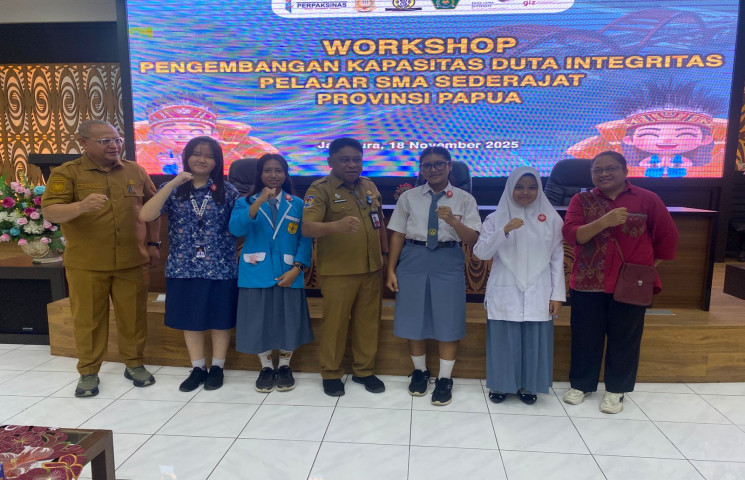
JAYAPURA – The Papua Provincial Government has reaffirmed its commitment to making schools a place where the character and integrity of the younger generation can be shaped. This commitment was emphasized during the capacity-building program for integrity ambassadors from senior high schools (SMA) and vocational schools (SMK), held at the Papua Communication and Information Office Hall on Tuesday (18/11/2025).
Papua Inspector General Danny Korwa stated that corruption can be prevented early within the education system by strengthening values such as honesty and responsibility. He emphasized that schools hold a strategic position as they shape students’ daily behavior.
According to Danny, integrity is not only a matter of knowledge but also a habit formed through consistent educational processes. He stressed the importance of involving teachers, school managers, and the broader education community in fostering an anti-corruption culture.
“Educational environments must be safe spaces for learning moral values and developing the courage to reject misconduct,” Danny said. He added that understanding Papua’s social and cultural context is also essential to ensure that integrity messages are effectively conveyed.
The activity, organized by ForPAK Papua in collaboration with the Inspectorate, the Education Office, and GIZ CPFS, is designed to strengthen the role of schools in anti-corruption campaigns. The training materials include public communication, campaign planning, and the development of creative activities based on local values.
Head of the Papua Education Office, Christian Sohilait, stated that character building must be an integral part of school management. He emphasized that many ethical issues in public spaces stem from weak integrity education during a person’s school years.
Sohilait noted that strengthening school capacity will have a broad impact on nearly 20,000 students of senior high schools and vocational schools in Papua. “We want schools to become centers of the integrity movement that can influence students’ behavior and their surrounding environment,” he said.
He explained that schools are also encouraged to use information media such as radio, television, and digital platforms to disseminate anti-corruption messages. This approach is expected to expand the reach of campaigns so that integrity values can be genuinely practiced in daily life.
Furthermore, this program builds on previous initiatives that established integrity ambassadors in various schools. “The government ensures that mentoring activities will continue sustainably to strengthen a clean and accountable education ecosystem in Papua,” he concluded. ***


