09Sep 26
- Admin Web Papua
- Bencana Daerah
- 897 x dilihat.

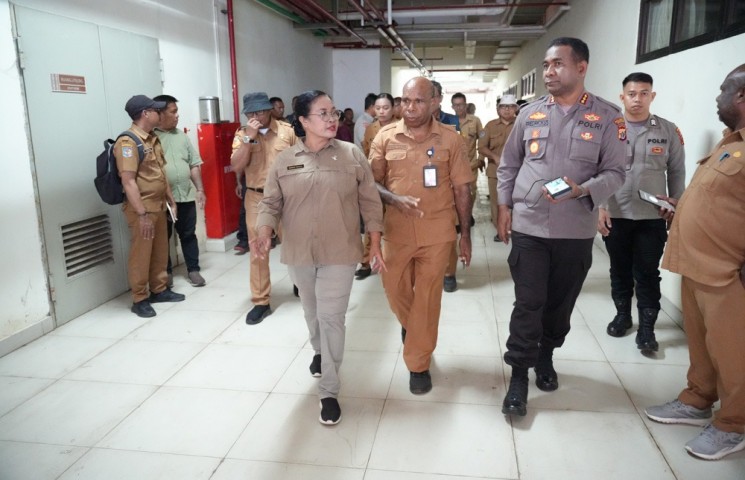
JAYAPURA – On the eighth day of the emergency response to the fire disaster in Dok V, Mandala Village, the Papua Provincial Government and the Jayapura City Government conducted a field inspection to assess the ongoing response for affected residents and prepare the transition toward recovery and rehabilitation.
The inspection was led by Papua Provincial Secretary Assistant III Suzana Wanggai, together with relevant regional government agencies. The visit focused particularly on assessing the readiness of facilities that will be used to relocate displaced residents from tents to more suitable temporary accommodation.
Suzana Wanggai said that as the emergency response period approaches its final stage, the government must ensure that all steps toward recovery are carried out in a planned and coordinated manner.
“We must ensure that residents who are still staying in tents can be moved as soon as possible to safer and more suitable locations. Therefore, the readiness of facilities, necessities, and the proper arrangement of displaced residents are our main priorities while we await the recovery and reconstruction process,” she said.
The relocation plan will be implemented gradually by utilizing facilities in the Mandala Stadium area, including the basement and parking area of Wisma Mandala, once all supporting facilities are confirmed to be ready.
Meanwhile, Papua Provincial Disaster Management Agency Head Robert Awi, who serves as the operational commander in the field, said the latest data showed that 399 households, comprising 2,169 people, had been affected by the fire. Of this total, 1,373 people are currently staying at the Mandala Stadium evacuation complex, while another 796 people are staying outside the evacuation site, including at relatives’ homes, rented houses, and other locations.
“Therefore, we continue to validate the data together with the Jayapura City Government. The response must not focus only on residents staying in tents, but also on affected people who are staying outside the evacuation site,” he explained.
Robert said the response for the victims has received active support from various regional government agencies according to their respective duties and responsibilities.
The Public Works and Spatial Planning Agency is supporting the preparation and arrangement of evacuation facilities, as well as preparations for temporary housing. The Youth and Sports Agency is supporting the readiness of facilities at Mandala Stadium and Wisma Mandala.
The Communication and Informatics Agency is providing free internet access for displaced residents, equipping the Integrated Command Post with multimedia and internet facilities, and mobilizing media personnel to support the dissemination of information.
The Library Agency is regularly providing educational support for displaced children through a mobile library service.
The Women’s Empowerment Agency is conducting trauma-healing activities to help address psychological impacts, particularly among women and children.
The Education Agency is collecting data on school-age children and providing solutions to address their educational administrative needs.
The Fisheries Agency is providing assistance and solutions for affected residents who work as fishermen.
The Social Affairs Agency is operating a public kitchen while also supporting the validation of population data. Meanwhile, the Health Agency continues to provide medical services, while the Civil Service Police Unit supports security and public order in the evacuation area.
The field inspection also assessed efforts to accelerate the provision of essential facilities, including site cleaning, clean water, bathrooms, septic tanks, spatial arrangements, children’s facilities, and electricity infrastructure.
All parties have been instructed to prepare and implement coordinated work plans as the remaining emergency response period becomes increasingly limited.
The Papua Provincial Government and the Jayapura City Government reaffirmed that the response will continue collaboratively as the situation transitions into the recovery, rehabilitation, and reconstruction phases.
The relocation of displaced residents is intended as an interim measure to ensure that affected communities have access to safe and adequate temporary accommodation. Meanwhile, the validation of victim data remains essential for determining needs and formulating response policies for the next stage.
All developments in the response effort are also being reported in an integrated manner through the Media Center/Integrated Command Post. ***


